Buying a set of irons is one of the biggest equipment decisions in golf, and there is a lot of marketing noise making it harder than it needs to be. Every manufacturer claims their irons are longer, more forgiving, and better-feeling than last year's model. The truth is simpler: the right iron set is the one that fits your swing speed, skill level, and the specific performance characteristics you need.
Here is how to cut through the noise and pick irons that actually improve your game.
02 · Iron CategoriesIron Categories
Game Improvement Irons are designed for the largest number of golfers.
They have wide soles, large clubfaces, deep cavities, and perimeter weighting that maximizes forgiveness on off-center hits. When you miss the sweet spot (which every golfer does), a game improvement iron loses less distance and stays closer to your target line than a thinner, less forgiving design.
These are the right choice for beginners, high handicappers (20+), and mid handicappers (10 to 20) who prioritize consistency over workability.
There is zero shame in playing game improvement irons. Most golfers, including many single-digit handicappers, play clubs in this category.
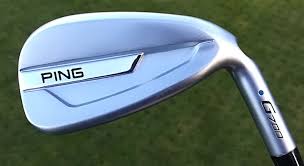
Players Distance Irons sit between game improvement and traditional player's irons. They offer some workability (the ability to shape shots intentionally) while retaining meaningful forgiveness. The soles are slightly narrower, the profiles are a bit more compact, and the feel is better than pure game improvement models.
This category has exploded in popularity because it serves the largest growing segment of the market: mid-handicappers who have outgrown super-forgiving irons but are not ready for (or do not want) a blade or thin players iron.
If you shoot between 80 and 95 regularly, this category is likely your sweet spot.
Players Irons (Blades and Muscle-Backs) are the thinnest, most compact designs with the least forgiveness. They offer maximum workability and feel, allowing skilled golfers to shape shots in both directions and control trajectory with precision. Miss the sweet spot and you feel it immediately in your hands and see it in the ball flight.
These are for low handicappers (under 5) and scratch golfers who have the consistency to find the center of the face regularly. If you do not strike the ball consistently well, blades will hurt your scores.
03 · Shaft SelectionShaft Selection
The shaft matters as much as (or more than) the clubhead. It controls the flex, weight, and feel of the entire club.
Steel shafts are the standard for irons.
They provide consistent feel, durability, and are available in a range of weights and flexes. Most golfers should play steel shafts in their irons unless they have a specific reason not to.
Graphite shafts are lighter and can help golfers with slower swing speeds generate more clubhead speed. They also reduce vibration, which is easier on the hands and joints. Seniors, women, and anyone with wrist or elbow issues often benefit from graphite iron shafts.
Flex should match your swing speed.
A rough guide: Regular flex for swing speeds of 75 to 90 mph (7-iron), Stiff for 90 to 105 mph, and Extra Stiff for 105+ mph. Playing a shaft that is too stiff for your swing speed leads to lower ball flight and shots that leak right. Too flexible and the ball flights will be higher and less controllable.
04 · Loft ConsiderationsLoft Considerations
Modern irons are lofted stronger (lower) than irons from 10 to 20 years ago.
A 7-iron that used to be 34 degrees is now 28 to 30 degrees in many game improvement sets. This makes the numbers on the bottom of the club less meaningful for comparing distance across different brands and eras.
A "7-iron" that goes 170 yards from one manufacturer might have the same loft as a "6-iron" from another. When comparing iron sets, look at the actual loft numbers, not just the club number.
The distance gains manufacturers advertise often come partly from stronger lofts rather than purely from better technology.
This stronger lofting also means gaps between clubs can be uneven. Check that the loft gaps between consecutive irons in the set are consistent (typically 3 to 4 degrees between each club). If the 7-iron is 28 degrees and the 8-iron is 33 degrees, you have a 5-degree gap that will show up as an awkward distance gap on the course.
05 · Set CompositionSet Composition
The traditional iron set ran 3-iron through pitching wedge. Today, most golfers are better served by starting their iron set at 5-iron or 6-iron and filling the long iron slots with hybrids. A 4-hybrid is easier to hit than a 4-iron for the vast majority of golfers, and it performs better from poor lies, rough, and tight fairways.
A practical iron set for most golfers: 5-iron through pitching wedge (6 clubs), paired with a 4-hybrid and possibly a 5-hybrid.
Add a gap wedge, sand wedge, and lob wedge to complete the scoring end of the bag.
06 · Getting FitGetting Fit
Club fitting is the single most impactful thing you can do when buying irons. A fitter measures your swing speed, attack angle, ball speed, and impact tendencies to recommend the right clubhead, shaft, lie angle, and grip size for your specific swing.
Fitting does not need to cost a fortune.
Many golf retailers (Golf Galaxy, PGA Tour Superstore, Club Champion) offer fittings, sometimes free with purchase. Even a basic fitting that dials in the right shaft flex, lie angle, and length makes a noticeable difference in consistency and accuracy.
If you cannot get fit, buying off the rack is still fine. Use the guidelines above for category, shaft flex, and set composition, and you will be in a good starting range.
You can always have clubs adjusted (lie angle bending, grip sizing) by a local pro shop later.
07 · Price and ValuePrice and Value
New premium iron sets from major manufacturers run $800 to $1,500 for 6 to 8 clubs. Previous-year models from the same manufacturers often drop to $500 to $800 and perform almost identically to the current models. The technology difference between a 2025 and 2026 iron set is marginal.
Pre-owned irons from reputable sources (GlobalGolf, 2nd Swing, Callaway Pre-Owned) offer even more value.
A two or three-year-old set in good condition can cost 40% to 60% of the original price and play just as well.
For beginners, a complete box set (irons, woods, putter, and bag) in the $300 to $500 range from Callaway Strata, Top Flite, or Wilson SGI is perfectly adequate until your game develops enough that you know what you need from a more specific iron set.
08 · The Bottom LineThe Bottom Line
Match the iron category to your skill level and be honest about it. Get fit if you can, or at minimum match the shaft flex to your swing speed. Do not obsess over the newest model. And play irons that help you score, not irons that look good in a magazine but punish every off-center strike.