
01 · The VerdictA lot of club for the money, and a lot of forgiveness for the miss.
A home golf simulator used to be a luxury reserved for people with dedicated rooms and five-figure budgets. That has changed dramatically. Launch monitor technology has improved and dropped in price, simulator software looks better than ever, and complete packages including screen, projector, and hitting mat are available for a fraction of what they cost five years ago.
Whether you want a full-room immersive setup or a portable launch monitor you can use in the garage, here are the best options in 2026.
02 · Best Premium Setup: Trackman iOBest Premium Setup: Trackman iO
Trackman is the standard that professional golfers and club fitters use.
The iO model is designed specifically for indoor use and delivers the most accurate ball tracking available in a home simulator. It uses radar technology combined with a camera system to capture ball speed, launch angle, spin rate, spin axis, and club data with precision that no competitor can match.
The simulator software library includes courses from around the world, and the graphics are the most realistic available.
The accuracy means that the distances and shot shapes you see on screen genuinely reflect what the ball would do outdoors. If you hit a 7-iron 160 yards on the course, it shows 160 yards on the simulator.
The price reflects the premium. A Trackman iO unit starts around $8,000, and a complete room setup with enclosure, screen, projector, and hitting mat pushes the total past $15,000 to $20,000.
This is for the golfer who wants tour-level accuracy and has the budget and space to support it.
03 · Best Mid-Range: Garmin Approach R10 + Screen PackageBest Mid-Range: Garmin Approach R10 + Screen Package
The Garmin Approach R10 brought launch monitor technology to the mass market at around $600. It sits behind the ball and uses Doppler radar to capture ball speed, launch angle, spin, club path, club face angle, and more.
The accuracy is not Trackman-level, but it is remarkably good for the price and more than sufficient for practice and entertainment.
Pair the R10 with a basic enclosure (impact screen, side netting, and frame from a company like PlayBetter or Rain or Shine Golf), a budget projector, and the E6 Connect simulator software, and you have a complete home simulator for $2,000 to $3,500 total.
The R10 connects to a phone or tablet via Bluetooth, and the Garmin Golf app provides a solid simulator experience with virtual courses and driving range modes.
For most recreational golfers, this setup provides 90% of the experience at 20% of the premium price.
04 · Best Budget: Rapsodo MLM2PROBest Budget: Rapsodo MLM2PRO
The Rapsodo MLM2PRO sits behind the ball and uses radar plus a camera to capture ball flight data including spin rate, which many budget monitors skip. At around $500 to $700, it delivers data accuracy that competes with units costing twice as much.
It works with the Rapsodo app for driving range mode and connects to E6 Connect and other simulator software for full course play.
The camera captures a video of your swing with each shot, which is a useful practice feature that the Garmin R10 does not include.
For a golfer who wants accurate data for practice and the option to play virtual rounds on a sim setup, the MLM2PRO is the best value in the current market. Pair it with a basic net and mat for outdoor use, or add a screen and projector for an indoor sim room.
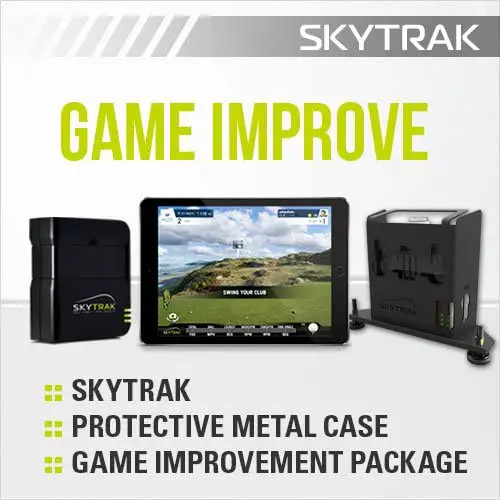
05 · Best All-in-One Package: SkyTrak+ with Retractable ScreenBest All-in-One Package: SkyTrak+ with Retractable Screen
SkyTrak has been a popular home simulator choice for years, and the SkyTrak+ model adds club data (path, face angle, attack angle) to the already-accurate ball data.
At around $2,500 for the unit, it sits in the sweet spot between the budget monitors and the premium Trackman.
Several companies sell complete SkyTrak+ packages that include the launch monitor, an impact screen with retractable frame (so you can use the space for other purposes when not golfing), a projector, hitting mat, and software subscription. These packages run $5,000 to $8,000 depending on the screen size and projector quality.
The retractable screen option is particularly appealing for garage setups where you need to park cars when not golfing. The screen rolls up to the ceiling, and you can be back in driving range mode in under a minute.
06 · Space RequirementsSpace Requirements
Before you buy anything, measure your space. The minimum room dimensions for a comfortable home simulator are roughly 10 feet wide, 15 feet deep (from screen to where you stand), and 9 feet tall (to allow a full driver swing without hitting the ceiling).
If your ceiling is 8 feet, you can still make it work for iron and wedge practice but may need to shorten your driver backswing.
Garages are the most common location. A standard two-car garage provides plenty of space. Single-car garages work if you are not trying to park a car alongside the simulator. Basements with 9-foot ceilings are ideal but check for support columns and ductwork that might interfere with your swing.
07 · Software OptionsSoftware Options
Most launch monitors work with multiple software platforms.
The major options are:
E6 Connect is the most widely compatible and includes dozens of real-world courses. The graphics are good (not photorealistic but well above average), and the gameplay is smooth. Subscription pricing is around $15 to $25 per month or a one-time purchase option.
GSPro is a community-driven software with hundreds of courses (many recreated from real courses by community members).
The graphics vary by course but the best ones look excellent. At $250 for a lifetime license, it is the most cost-effective option for course variety.
TGC 2019 (The Golf Club 2019) offers the most photorealistic graphics and the deepest course library (over 100,000 user-created courses). It runs on a gaming PC, which adds to the total cost if you do not already have one.
08 · The Honest AssessmentThe Honest Assessment
A home simulator is not a replacement for playing actual golf outdoors.
It is a supplement. It is phenomenal for practice, for staying sharp during winter months, and for entertainment with friends. The ball flight data helps you understand your swing and club distances better than you can on a range where you are guessing at carry distances.
If you have the space and a budget of at least $2,000, a home simulator setup is one of the most enjoyable investments a golfer can make. If you are just starting and want to test the waters, a Garmin R10 or Rapsodo MLM2PRO with a basic net gets you started for under $1,000 before committing to a full room build.
09 · Specs & FitWhat you get in the box.
◆ Handicap Fit · Tester Consensus
10 · Pros & ConsThe short version.
- Mishit forgiveness that flatters the average amateur swing.
- Launch window suits mid-handicap swing speeds (78–92 mph).
- Hybrid replacements are genuinely playable, not token additions.
- Price-to-performance is the best in the golf technology category right now.
- Feel on pure strikes is muted versus forged competition.
- Wide sole can be a liability on firm, tight lies.
- Offset is generous — faders will need to account for it.
- Stock grip is functional but forgettable.
11 · AlternativesIf this one isn't right for you.
Best Golf Rangefinders Under $300