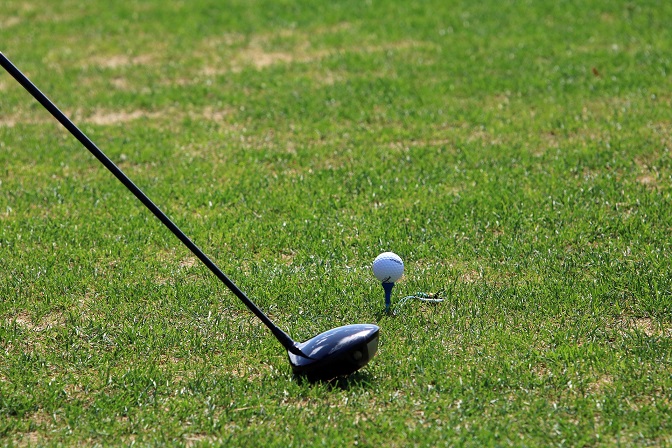
Not every week allows for a trip to the range, and winter weather can shut down your practice routine for months. But your golf game does not have to stall just because you cannot get to the course. With some basic equipment and a bit of creativity, you can work on almost every part of your game from your living room, garage, or backyard.
02 · Putting PracticePutting Practice
Putting is the easiest skill to practice at home and the one that will shave the most strokes off your score.
A basic putting mat costs $20 to $50 and fits in any room. Here are three putting drills you can do on any flat surface:
Gate Drill. Set up two tees or coins about one putter head width apart, a few inches in front of your ball. Practice rolling putts through the gate. This trains a square putter face at impact.
Distance Control. Place a towel or book at the far end of your mat and try to stop the ball as close to it as possible without going past.
Clock Drill. Place balls at 3, 6, 9, and 12 feet from the hole and work around the clock.
If you miss one, start over.
03 · Chipping in the BackyardChipping in the Backyard
If you have any kind of yard space, chipping practice is easy to set up. Place a bucket, towel, or small target 10 to 30 yards away. Use foam or practice balls if you are concerned about windows. Focus on keeping your weight slightly forward, letting the bounce interact with the turf, and matching the length of your backswing to the distance you want.
04 · Full Swing with a Net or Impact ScreenFull Swing with a Net or Impact Screen
A golf hitting net lets you take full swings at home.
Basic nets start around $50 for a pop-up model. Pairing a net with a launch monitor like the Garmin Approach R10 or Rapsodo MLM2PRO changes the game entirely, giving you real feedback on every swing. Even without a launch monitor, hitting into a net is valuable for maintaining your swing tempo and working on contact.
05 · Mirror Work and Alignment DrillsMirror Work and Alignment Drills
One of the most underrated practice tools is a full-length mirror.
Stand in front of it with a club and check your setup: grip, posture, ball position, and alignment. Many swing faults start with a poor setup, and a mirror makes these easy to spot and fix. Practice your takeaway and backswing in slow motion. Alignment sticks are another cheap tool for indoor practice.
06 · Grip Strength and Flexibility TrainingGrip Strength and Flexibility Training
Wrist curls and reverse wrist curls. Strong wrists and forearms help you maintain control through impact. Rotation exercises. Practice thoracic spine rotations by sitting in a chair, crossing your arms, and rotating your upper body as far as you can in each direction. Hip flexor stretches. A simple kneeling hip flexor stretch held for 30 seconds each side makes a real difference. Single-leg balance. Stand on one foot for 30 to 60 seconds, then switch.
07 · Visualization and Mental GameVisualization and Mental Game
Spending 10 minutes visualizing your round, your swing, or specific shots you want to hit is genuinely beneficial. Research on sports performance consistently shows that mental rehearsal activates the same neural pathways as physical practice. Pick a course you play regularly, close your eyes and play through each hole.
08 · Swing Speed TrainingSwing Speed Training
Overspeed training protocols like the SuperSpeed Golf system are designed for at-home use. You swing lightweight clubs as fast as possible to train your neuromuscular system to produce more speed. A basic set costs around $200. Many golfers report gaining 5 to 8 mph of clubhead speed within a few months, which can translate to 15 to 25 extra yards off the tee.
09 · Building a Home Practice RoutineBuilding a Home Practice Routine
Consistency beats intensity. Fifteen minutes of focused practice every day is better than a two-hour session once a week. Here is a simple daily routine:
- 5 minutes of putting drills on a mat
- 5 minutes of slow-motion swing work in front of a mirror
- 5 minutes of stretching and rotation exercises
The golfers who improve the fastest are the ones who touch a club every day, even if it is just for a few minutes. Your home practice does not need to be complicated. It just needs to be consistent.