If you could only buy one training aid for the rest of your golf life, make it alignment sticks. They cost almost nothing, fit in any bag, and address the single biggest problem in amateur golf: poor alignment. Most golfers think they are aimed at the target when they are actually pointed 10 to 20 yards right or left. Alignment sticks fix that instantly.
But they do a lot more than just alignment work.
You can use them to check swing plane, train path, groove tempo, and build a consistent setup routine. Here are the best sticks and aids on the market.
02 · Tour Sticks Standard Alignment SticksTour Sticks Standard Alignment Sticks
Tour Sticks are the industry standard. They are 48 inches long, made from flexible fiberglass, and come in multiple colors. The flexibility matters because you can stick them in the ground at angles to create swing plane guides, or lay them flat for alignment and ball position checks.
A basic two-stick setup covers most practice needs.
Lay one stick on the ground parallel to your target line about a foot outside the ball. Lay the second one parallel to the first, aligned with your feet. Now your body alignment matches your target alignment, and you can actually tell if your swing is producing the shot shape you want.
Tour Sticks are durable enough to take thousands of practice sessions without breaking. They come in a tube for storage and travel.
The price is about $20 to $25 for a pair.
03 · Callaway Alignment StixCallaway Alignment Stix
Callaway Alignment Stix are essentially the same product as Tour Sticks with the Callaway branding. They are 48 inches, fiberglass, and come with a durable tube. The performance is identical. If you prefer the Callaway name or find them on sale, they are a perfectly good option.
What Callaway adds is a short instruction guide with the sticks that shows basic drills for alignment, swing plane, and putting.
For a golfer new to training aids, that included guide might be enough to justify the slight price premium over generic sticks.
Price is about $25 to $30 for a set of two.
04 · Orange Whip TrainerOrange Whip Trainer
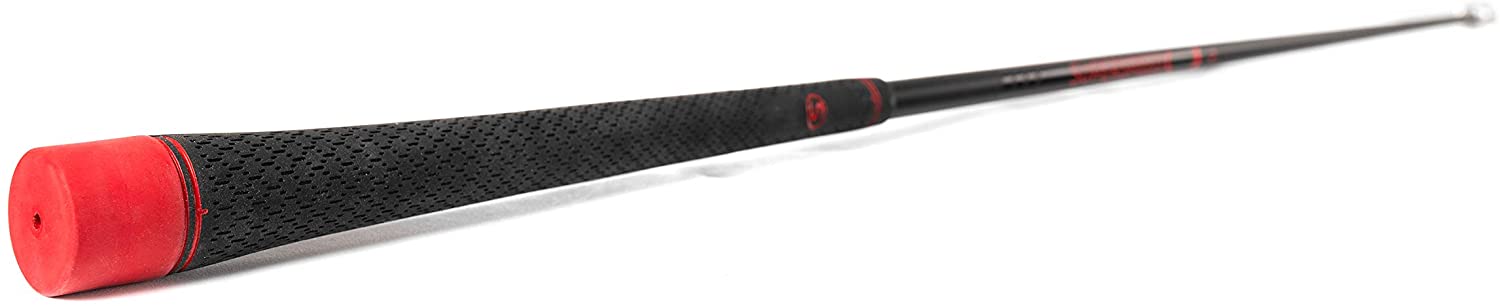
The Orange Whip is not an alignment stick, but it is one of the best overall training aids in golf so it belongs in this category. It is a weighted, flexible shaft with an orange ball on the end. Swinging it builds tempo, balance, and the feeling of a properly sequenced swing.
The flex in the shaft gives you immediate feedback.
If you rush the transition from backswing to downswing, the whip lags and you feel it. If you swing in sequence (lower body leads, torso follows, arms follow that), the whip loads and releases smoothly with a satisfying swoosh.
It doubles as a warm-up tool. Ten swings with the Orange Whip before a round loosens up your shoulders, core, and hips better than static stretching. Many touring professionals use it on the range before tournament rounds.
The full-size version is 47 inches and weighs about 1.75 pounds.
Mid-size (44 inches) and compact (36 inches) versions are available for smaller players or limited-space practice. Price runs $100 to $120 depending on size.
05 · SKLZ Gold Flex Swing TrainerSKLZ Gold Flex Swing Trainer
The Gold Flex is a more affordable alternative to the Orange Whip. Same concept: weighted, flexible shaft that trains tempo and sequence. The execution is slightly different.
The Gold Flex uses a heavier weight on a thinner, more whippy shaft. The feel is less refined than the Orange Whip, but the training effect is very similar.
It comes in 40-inch and 48-inch versions. The shorter version works well for indoor practice and as a travel warm-up tool. The longer version provides a more realistic full-swing feel.
At $30 to $40, the Gold Flex delivers about 80% of the Orange Whip experience for a third of the price.
If budget matters, this is the better buy.
06 · Putting Alignment MirrorPutting Alignment Mirror
For putting practice, an alignment mirror is incredibly effective. You place the mirror on the ground, set your ball on the marked position, and address the putt while looking down at your reflection. The mirror shows you exactly where your eyes are positioned relative to the ball (they should be directly over it or slightly inside), whether your shoulders are square to the target line, and whether the putter face is aimed where you think it is.
Most golfers are shocked the first time they use one. What feels square is often open or closed by several degrees. The visual feedback from the mirror corrects this in a few practice sessions.
The Eyeline Golf Putting Alignment Mirror is the most popular version. It is compact, lies flat, and has lines for eye position, shoulder alignment, and putter path. Price is about $25 to $35.
07 · How to Actually Practice with These ToolsHow to Actually Practice with These Tools
Alignment sticks should be part of every range session. Set them up before you hit your first ball and leave them down the entire time. Practicing without alignment reference is like driving without a windshield. You might get where you are going, but you will not know how you got there.
Use the weighted trainers (Orange Whip or Gold Flex) as warm-up tools before practice and rounds. Ten to fifteen slow, smooth swings set your tempo for the session. Do another set of swings at the end to reinforce the feeling before you leave.
The putting mirror should be used for at least 10 minutes at the start of every putting practice session. Nail your setup alignment first, then putt without the mirror to see if the corrections hold. Go back to the mirror if things start drifting.
Training aids only work if you use them consistently. Buying them is not the hard part. Building the habit of setting them up every time you practice is where the real improvement happens.